Why Ethiopia’s Wartime Allies Keep Becoming Enemies
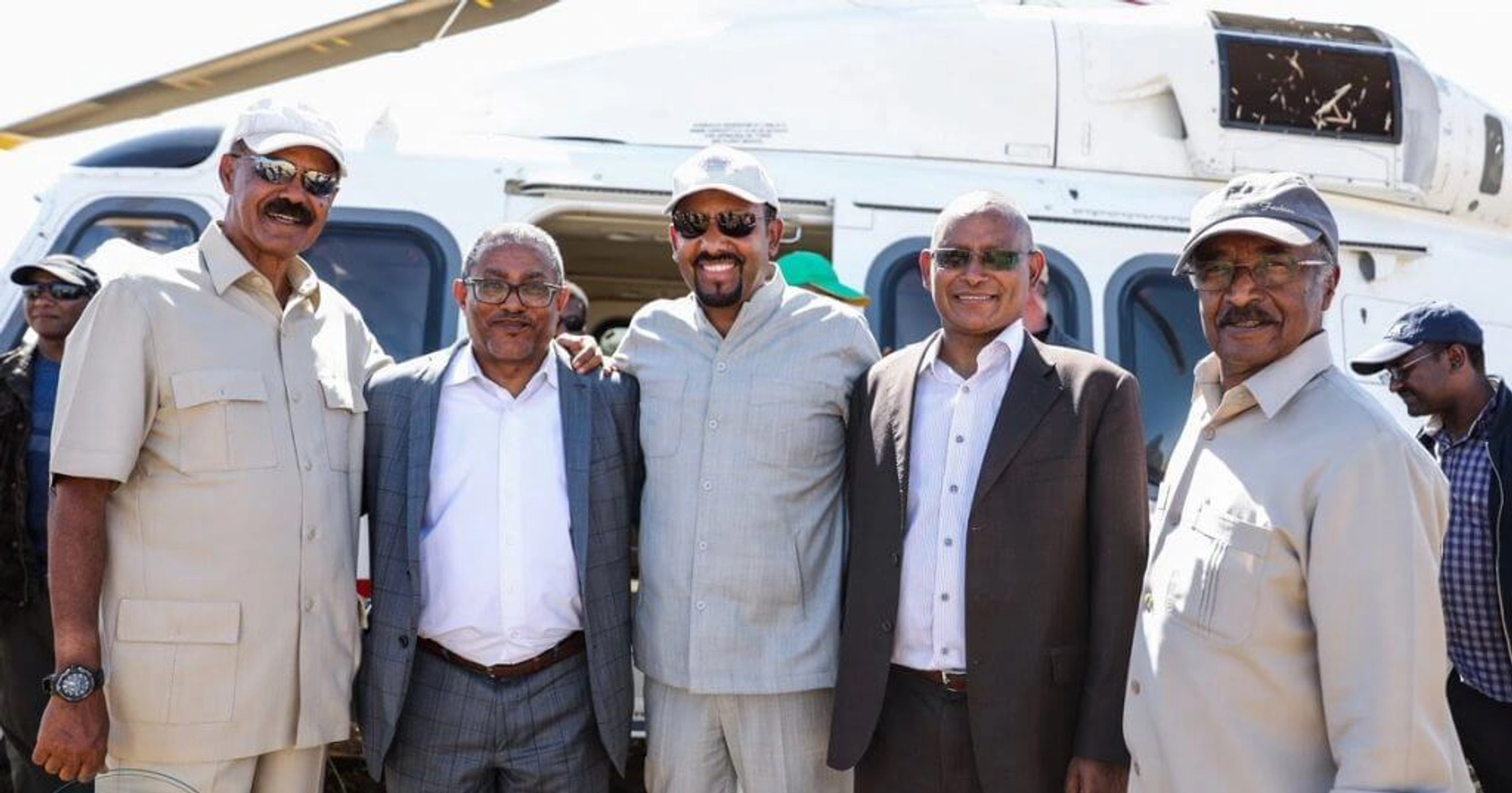
From left: President Isaias Afwerki, Ethiopia’s (former) Foreign Minister Gedu Andargachew, Prime Minister Abiy Ahmed, Tigray Region President Debretsion Gebremichael, and Eritrean Foreign Minister Osman Saleh pose for a photo at the official reopening of the Omhajer-Humera border crossing on January 7, 2019. (Photo: PM Office)
In September 2026, an extraordinary political development took place in Ethiopia. Seven armed opposition movements announced the formation of a new alliance against the government of Prime Minister Abiy Ahmed. Among them were organizations whose members had fought on opposite sides of one of the most devastating wars in contemporary African history.
The Tigray People’s Liberation Front (TPLF) and Amhara nationalist armed movements, antagonists during the 2020–2022 Tigray War, are now within the same declared opposition coalition. The Oromo Liberation Army (OLA) and other movements with distinct political histories and territorial ambitions have also joined. Only a few years earlier, such a configuration would have appeared inconceivable.
Consider another reversal.
In 2018, Ethiopia and Eritrea celebrated a historic reconciliation, with their leaders publicly embracing each other after two decades of hostility. In 2020, Ethiopian and Eritrean forces fought on the same side against the TPLF. Yet by October 2026, the two governments were trading accusations of military aggression, and renewed fighting in northern Ethiopia had brought the danger of interstate war back to the forefront of regional diplomacy.
These reversals raise a fundamental question. How did yesterday’s enemies become today’s allies, only for today’s allies to become tomorrow’s enemies? The usual explanation is that politics is driven by interests, that alliances are temporary, and that there are no permanent friends or enemies. There is some truth to this observation, but it is analytically inadequate.
It tells us that political alignments change without explaining why particular alignments emerge, why they survive some crises but not others, why they collapse at specific moments, and why the collapse of one coalition so often produces the conditions for another war.
The argument is that Ethiopia’s recurrent alliance reversals cannot be understood simply as opportunism, ethnic antagonism, ideological inconsistency, or the ambitions of individual leaders. They reflect a deeper political contradiction.
Ethiopian political and military actors have repeatedly been able to agree on whom they wish to defeat without reaching a durable agreement on the political order they wish to establish afterward. They have built coalitions capable of winning battles, overthrowing governments, changing national leadership, and fundamentally altering regional balances of power. But these same coalitions have struggled to establish mutually acceptable arrangements over political authority, territorial jurisdiction, command of armed forces, control of economic resources, and guarantees against renewed exclusion.
This is what I call the coalition–settlement gap: the distance between the political and military cooperation necessary to confront a common adversary and the institutional agreement necessary to govern once that adversary is weakened or removed. It is a distinction with profound consequences, for a coalition can succeed militarily while failing politically.
Indeed, under certain conditions, military success itself can accelerate political fragmentation. To understand why, we must look beyond the immediate events of 2018–2026 and examine the historical processes that produced Ethiopia’s contemporary political order.
How revolutionary allies became enemies
The historical record begins with the revolutionary struggles of the 1970s and 1980s. The struggle against Ethiopia’s military government brought together armed movements with different political identities, ideological positions, organizational interests, and visions of the future state.
Among the most consequential were the Tigray People’s Liberation Front (TPLF) and the Eritrean People’s Liberation Front (EPLF.) Both confronted the Derg. Both operated within the wider revolutionary politics of the Horn of Africa. And both recognized the strategic advantages of cooperation. Yet their relationship was never as straightforward as the retrospective image of revolutionary solidarity sometimes suggests.
The two organizations disagreed over political strategy, ideological questions, organizational autonomy, and the relationship between national liberation and revolutionary transformation. Their disagreements contributed to a rupture in 1985, when the EPLF severed cooperation and restricted TPLF supply routes during the devastating famine. Cooperation only resumed in 1988 as the military struggle against the Derg entered a decisive phase.
The important lesson here is not merely that they quarrelled and reconciled. It is that neither their earlier differences nor their subsequent cooperation can be explained adequately without examining the changing relationship between military necessity and political ambition. When their separate struggles required cooperation, accommodation became strategically valuable. But cooperation against the Derg did not eliminate disagreements about sovereignty, authority, and the future relationship between Ethiopia and Eritrea.
By 1998, the governments that had emerged from these allied liberation struggles were at war. The border dispute was the immediate focus of the conflict, but it developed against a background of deteriorating political relations and disagreements over economic arrangements, including currency, trade, and access to ports.
In 1991, revolutionary victory transformed these organizations from insurgent movements into dominant political authorities. And with that transformation, the basis of their relationship fundamentally changed. Yesterday, they had confronted a common state. Now they governed separate political jurisdictions and had to negotiate the practical consequences of Eritrean independence. Borders, sovereignty, monetary arrangements, ports, trade, and economic policy were no longer secondary matters that could be deferred in the interest of revolutionary victory. They became questions of state power.
There is an important theoretical lesson here. A common enemy can sustain military cooperation without producing compatible understandings of sovereignty. The transition from insurgency to government changes what actors are defending, what they can demand, and what they stand to lose. The Ethiopian–Eritrean War demonstrated how a revolutionary partnership could give way to interstate rivalry when previously deferred conflicts became matters of sovereign authority.
But a second development, within Ethiopia itself, is equally illuminating.
The post-1991 power struggle
The Ethiopian People’s Revolutionary Democratic Front emerged from the anti-Derg struggle as the country’s dominant governing coalition. It is tempting to treat its subsequent longevity as evidence that Ethiopia once possessed a stable and successful coalition-building model, but that interpretation requires qualification.
The EPRDF maintained power for nearly three decades, but its organizational durability rested substantially on centralized party structures, hierarchical relationships, security institutions, and an unequal distribution of decision-making authority among its constituent organizations. The coalition’s endurance did not mean that its members possessed equivalent political power or that all significant social and political constituencies had accepted the settlement.
The experience of the Oromo Liberation Front (OLF) is instructive here.
The OLF participated in Ethiopia’s transitional political arrangements after the overthrow of the Derg. Yet by 1992, disputes over electoral conditions, military control, political representation, and the organization of authority had contributed to its withdrawal from the transitional government and renewed armed confrontation.
Notice the sequence.
The overthrow of the Derg created an opportunity for cooperation. The establishment of a transitional government required decisions about who would actually exercise power. Those decisions exposed the unequal military and institutional positions of the participating organizations. The central problem was not simply whether the parties endorsed political pluralism or self-determination in principle. It was whether their commitments could be translated into arrangements that allowed competitors to participate without surrendering their capacity to protect themselves. This distinction would return, with remarkable force, three decades later.
The EPRDF’s subsequent history also exposes an important paradox. Centralized organizational control can suppress open conflict among coalition partners. It can produce continuity, discipline, and the appearance of institutional coherence. But organizational subordination is not the same as an agreed distribution of political authority. When the mechanisms sustaining that hierarchy weaken, previously contained conflicts can reappear in new forms. That is precisely why the crisis that culminated in 2018 must be understood as more than a change of leadership.
The alliance that brought Abiy Ahmed to power — and its limits
The political transition of 2018 was born out of a profound crisis within Ethiopia’s ruling order. Mass protests, particularly in Oromia and Amhara, had undermined the legitimacy of the governing coalition. Political and organizational realignments within the EPRDF weakened the previously dominant position of the TPLF. Abiy Ahmed’s accession to the premiership therefore represented both a response to demands for reform and a significant redistribution of power within the governing establishment.
These two processes were closely connected, but they were not identical. The initial convergence among influential Oromo and Amhara political actors helped produce the leadership transition. Yet that convergence did not mean that they possessed a common constitutional project.
Different actors anticipated different outcomes from the transition.
Some expected a stronger federal government capable of transcending the divisive consequences of ethnicized political competition. Others expected a more equitable distribution of authority within the existing federal framework. Still others sought the recognition of historical claims, regional security interests, or greater autonomy.
These expectations could coexist while the immediate objective was to displace the previous concentration of power. They became harder to reconcile once the question changed from who should lead the reform process to what institutional order reform should produce.
The creation of the Prosperity Party in 2019 sharpened this contradiction. For the prime minister and his supporters, the party represented an effort to overcome the limitations of the EPRDF’s organizational structure and consolidate a new governing arrangement. For the TPLF leadership, which declined to join, it threatened the inherited distribution of authority and raised fundamental concerns about the direction of the federal system.
The conflict was therefore not reducible to personalities. It concerned who possessed the authority to reorganize the ruling order, how federal and regional powers were to be interpreted, and which institutions would arbitrate disagreements between competing political authorities.
At the same time, the 2018 reconciliation with Eritrea introduced an external dimension to Ethiopia’s internal realignment. For Abiy Ahmed, reconciliation promised to end a prolonged confrontation, transform Ethiopia’s regional relationships, and strengthen the new government’s diplomatic position. For Eritrea’s leadership, the weakening of the TPLF’s dominance in Addis Ababa removed a major obstacle to rapprochement.
But the public normalization of interstate relations did not settle the question of how the new relationship would affect Tigray, Ethiopia’s internal balance of power, or the regional security order. The danger lay in the intersection of these processes. Domestic political restructuring, an unsettled federal relationship, and a fundamental change in Ethiopia’s external alliances were unfolding simultaneously. The institutions capable of managing those changes peacefully proved insufficient.
I’ve reorganized the essay into fuller, more coherent paragraphs, combining standalone sentences with the paragraphs they logically belong to. I have preserved the original wording, arguments, headings, and references without adding or removing words.
The Tigray War united forces with conflicting goals
The outbreak of the Tigray War in November 2020 marked a catastrophic escalation of these unresolved political conflicts. It involved the Ethiopian federal government, the TPLF and Tigrayan forces, Eritrean military intervention, and Amhara regional forces and militias, among other actors. The federal government, Eritrean authorities, and Amhara armed formations cooperated against the TPLF. Yet we must be careful not to assume that military cooperation meant agreement over political objectives.
For Ethiopia’s federal leadership, the confrontation involved the authority of the central government, the status of the TPLF, and the future distribution of coercive power. For Eritrea’s government, the conflict concerned a longstanding adversary and the security balance along its southern border.
For important Amhara political and military actors, the war also intersected with territorial claims, regional security concerns, and disputes over territories administered by Tigray before the conflict. These interests overlapped, but they were not interchangeable. Their convergence created military cooperation. Their differences created competing expectations about what the outcome of the war should mean.
Here, the political economy matters. Wars do not simply redistribute military advantage. They reshape control over territory, roads, border crossings, public institutions, land, economic activity, and populations. An actor’s contribution to a war can strengthen its claim to political recognition afterward. Control established during wartime can become a source of administrative authority or bargaining leverage. But what one participant regards as the legitimate outcome of wartime sacrifice, another may regard as an unacceptable alteration of the constitutional or territorial order.
This is particularly evident in the disputes over western Tigray, also claimed as Welkait and surrounding areas by Amhara actors. These are not merely disputes about lines on a map. They concern the authority to govern, the rights of displaced people, competing claims to land, the location of security forces, and the ability of communities to return to their homes. For affected civilians, the consequences are immediate and material. For political and military organizations, territorial control also affects legitimacy, coercive capacity, and bargaining strength. A peace agreement that does not resolve these issues can stop major battles while leaving the foundations of subsequent confrontation intact. And that brings us to Pretoria.
Why Pretoria Left Key Disputes Unresolved
The agreement signed in Pretoria on 2 November 2022 was a major diplomatic achievement. It helped bring an end to the large-scale war between the Ethiopian federal government and Tigrayan forces. It created commitments concerning cessation of hostilities, humanitarian access, restoration of services, disarmament, federal authority, and political normalization. Its achievements must not be minimized. After an extraordinarily destructive conflict, stopping the fighting was itself a profound human and political necessity. But we must distinguish the achievement of a ceasefire from the construction of a durable political settlement.
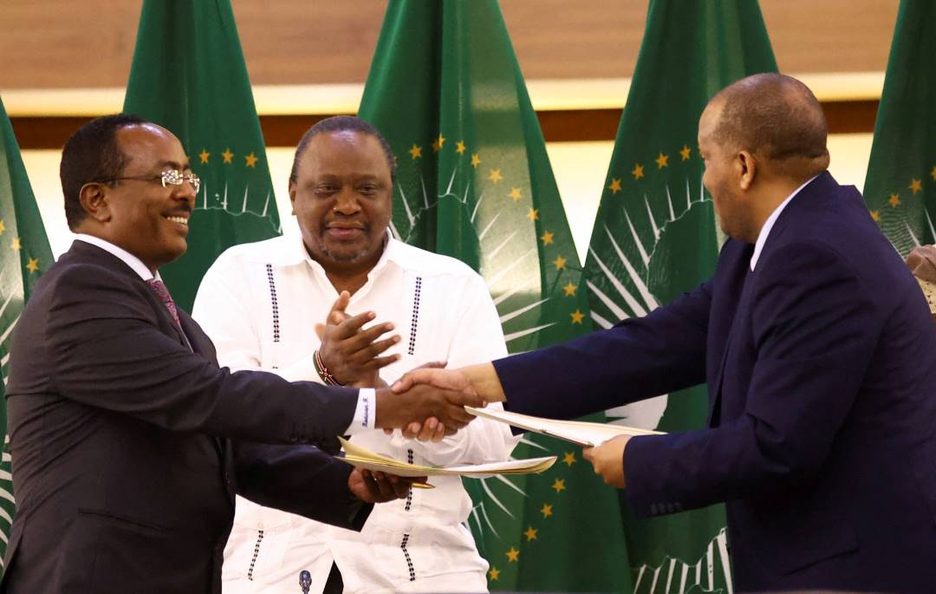
Pretoria was principally an agreement between the Ethiopian federal government and the TPLF. Eritrea was not a signatory. Neither were the Amhara armed formations that had participated in the war. This fact does not, by itself, prove that the agreement was defective. Peace negotiations frequently begin with the principal belligerents and subsequently incorporate wider questions. The decisive issue is what happens to the interests, capabilities, and security concerns of actors outside the initial bargain.
If an agreement redistributes authority between two parties while leaving other armed actors uncertain about their future, those actors may perceive the settlement as a threat. If territorial disputes remain unresolved, competing authorities retain incentives to defend or improve their positions. If disarmament is required without credible security guarantees, relinquishing weapons can appear dangerous to those being asked to disarm. And if commitments are not implemented in a credible, reciprocal, and verifiable manner, even an initially successful peace process can lose political support.
Pretoria therefore presents us with a particularly important analytical question: Why did the end of the federal–TPLF war fail to produce a corresponding stabilization of the relationships among the broader wartime actors? The subsequent deterioration of Ethiopia’s federal–Amhara and Ethiopia–Eritrea relationships suggests that the answer lies partly in the divergence between the agreement reached by its signatories and the unresolved interests of other participants in the conflict. But the explanation must also account for decisions made after the agreement: the implementation of security reforms, changes in territorial control, political fragmentation within Tigray, and the evolution of regional threat perceptions. In other words, the post-Pretoria crisis was neither an unavoidable consequence of the agreement’s design nor simply the product of individual actors refusing peace. It emerged through a succession of political decisions made within an unsettled security environment.
How the wartime alliance began to unravel
The federal–Amhara rupture provides a particularly revealing example. During the Tigray War, Amhara regional forces and Fano formations made significant contributions to the war effort alongside federal forces. Yet in April 2023, the federal government’s decision to reorganize regional special forces and integrate their members into other security institutions generated resistance, particularly in Amhara. The policy could be defended as an attempt to establish a more coherent national security system and reduce the autonomy of regional military organizations. But its political consequences cannot be understood from its declared administrative objective alone.
For actors concerned about territorial disputes and the security of Amhara communities, the proposed restructuring raised a different question: Would they lose their capacity to defend their interests while the disputes that had justified their mobilization remained unsettled? What appeared to the federal government as an institutional reform was interpreted by important regional actors as a change in the distribution of coercive power. The resulting confrontation was not simply a disagreement over administrative organization. It exposed incompatible understandings of the postwar security order.
By 2023, the federal government was confronting armed movements in Amhara, some of whose members had previously fought alongside it. The alliance had not merely weakened. Its principal participants had come into armed conflict. This is the coalition–settlement gap in concrete form. Wartime cooperation generated neither a settled agreement on the future distribution of security authority nor a mutually trusted process for deciding it.
A related, although distinct, transformation took place in Ethiopia’s relationship with Eritrea. Their 2018 reconciliation had become a military partnership during the Tigray War. But after Pretoria, their interests diverged. Eritrea’s exclusion from the agreement, disagreements over the regional security environment, and Ethiopia’s increasingly prominent pursuit of improved access to the Red Sea all formed part of the deterioration.
The Red Sea question is especially consequential because it concerns more than commercial access. For Ethiopia, secure and affordable maritime access carries enormous economic and strategic significance. For Eritrea, the same discussion can raise questions about sovereignty, territorial security, and the intentions of a much larger neighboring state. The distinction between negotiated commercial access and claims implying sovereign territorial rights is therefore essential. When the security interests of neighboring states are interpreted in incompatible ways, economic geography becomes part of the strategic conflict.
Meanwhile, the TPLF itself experienced serious internal divisions. Disagreements over the implementation of Pretoria, the legitimacy of the interim administration, relationships with Addis Ababa, and control of Tigray’s political and security institutions contributed to competing centers of authority.
These developments remind us that alliances do not fragment only between organizations. They can also fragment within them. A political organization may enter a peace agreement as a negotiating party but subsequently find that its leaders, commanders, and constituencies disagree about what the agreement requires and who possesses the authority to implement it. The crisis of a coalition can therefore become a crisis of organizational representation.
Former Enemies Reunited in 2026
The most remarkable development of the present period came next. In September 2026, the Ethiopian Peoples’ Forces Alliance for Survival was announced. Its composition brought together political-military organizations whose histories include serious ideological disagreements, territorial disputes, and, in some cases, direct armed confrontation.
How should we interpret such an alliance? One explanation is that the perceived threat posed by the federal government has become sufficiently important for participating organizations to subordinate their differences to a common immediate objective. This is a plausible explanation, and the alliance’s public declarations are consistent with it. But it would be a mistake to conclude that shared opposition necessarily constitutes a unified political project.
An announcement is not the same as an operational military alliance. Operational cooperation is not the same as integrated command. And agreement on removing a government is not the same as agreement on the political system that should replace it. For the contemporary opposition alliance, therefore, the crucial questions concern not only its military capabilities, but also its proposed future settlement.
What understanding exists concerning Ethiopia’s federal structure? How would competing territorial claims be adjudicated? What guarantees would prevent a victorious participant from dominating the others? What would happen to the armed forces of the participating organizations? And which institutions would protect constituencies whose representatives rejected particular elements of a future agreement? Unless these questions are addressed, the alliance could reproduce the political contradictions that undermined previous coalitions. This is a question, not a prediction. The new alliance’s durability and operational coherence remain to be established.
The same analytical caution is necessary concerning Eritrea and Tigrayan political factions. Contacts and reported cooperation between actors who previously fought each other indicate a significant change in the regional alignment. Yet assertions concerning covert military support must be distinguished from independently documented operations and formal commitments.
By October 2026, renewed fighting in northern Ethiopia and sharply escalating Ethiopian–Eritrean accusations had demonstrated how rapidly the regional environment could deteriorate. Developments around Adigrat and Zalambessa have renewed international concern about wider war. These events remain fluid and contested. But one conclusion is already warranted. The alignment that helped shape the military campaign of 2020 no longer defines the regional political order. And its transformation has brought back unresolved questions concerning sovereignty, territorial security, armed authority, and the future of Ethiopia’s federal system.
Why these wartime alliances keep collapsing
What, then, does Ethiopia teach us about wartime coalitions more generally? The existing scholarship provides essential insights. Fotini Christia has demonstrated the importance of relative power in explaining alliance formation and switching during civil wars. Michael Woldemariam has also shown how organizational cohesion, battlefield circumstances, and insurgent fragmentation shape the trajectories of armed movements. Research on political settlements emphasizes the relationship between the distribution of power and the institutions through which competing actors negotiate and enforce political bargains.
Ethiopia’s history allows us to connect these insights in a distinctive way. Three mechanisms stand out. The first is threat convergence. Organizations with incompatible political projects can cooperate when they regard a common adversary as the more immediate danger. The second is asymmetric wartime empowerment. Coalition participants rarely emerge from war with equal military resources, institutional influence, territorial control, or political legitimacy. Indeed, their participation in the war may enlarge the very differences that later destabilize the partnership. The third is the failure of credible settlement guarantees. When coalition members cannot trust the institutions responsible for enforcing political agreements, surrendering military power can mean surrendering their future bargaining position. The resulting insecurity encourages organizations to retain independent coercive capabilities, resist implementation, or seek new partners.
These mechanisms interact. Threat convergence makes cooperation possible. Unequal wartime empowerment alters the bargaining relationship. Unresolved political claims and weak enforcement make continued cooperation uncertain. Once the original threat recedes—or a new threat emerges—coalition members reassess their interests. Some remain aligned. Others defect. Still others cooperate with former enemies. But these outcomes are not inevitable.
A coalition is more likely to endure where its members accept authoritative decision-making institutions, possess credible guarantees against exclusion, and have workable procedures for resolving territorial and distributive disputes. The distinction matters because it prevents us from explaining every breakdown after the fact as an unavoidable consequence of conflicting interests. The real theoretical challenge is to explain why some disagreements remain manageable while others become grounds for renewed war. And that requires us to take political institutions seriously.
The money, territory and power behind the fighting
There is another dimension that deserves greater attention. Ethiopia’s conflicts are often described primarily through the language of ethnicity, ideology, and political leadership. These are indispensable dimensions, but they are not sufficient. We must also investigate the political economy of coalition formation.
Who finances military mobilization? Who controls transport corridors, customs points, commercial networks, public employment, and the institutions that allocate scarce resources? Who benefits from control over disputed territory? How are wartime sacrifices converted into claims to offices, security authority, land, and economic opportunities? And whose losses remain unrecognized when political leaders negotiate a new arrangement? Such questions are necessary because political coalitions are also arrangements for distributing power and material advantage.
The accumulation of resources during conflict can give armed actors greater autonomy. That autonomy may allow them to resist subordination within a settlement. Conversely, when central authorities attempt to recover command over security institutions or economically strategic territory, formerly allied actors can interpret these measures as threats to their survival.
This does not mean that every political claim is merely a disguised economic interest. Claims concerning identity, self-determination, historical injustice, and collective security are real political motivations. But they are expressed within institutional arrangements that distribute resources and coercive capabilities unequally. A political settlement that ignores this distribution may achieve temporary consent without altering the incentives that drive renewed confrontation. And a peacebuilding process that addresses only elite representation while neglecting displacement, land rights, livelihoods, and public accountability risks producing peace among negotiators without security for the population.
What Ethiopia needs to make peace last
Three implications follow. First, the removal or defeat of a common adversary should never be confused with agreement on a successor political order. This is as relevant to the government as it is to its armed opponents. Ethiopia’s emerging coalitions should therefore be judged not simply by whom they oppose or their ability to mobilize military forces, but by the political future they are capable of negotiating—and by the institutions they are willing to establish to constrain their own power and allow political competitors to survive losing it.
Second, security reform must be linked to credible political guarantees. A state cannot sustain multiple armed organizations indefinitely without serious challenges to public authority. But the consolidation of military command is unlikely to produce lasting peace if affected groups believe that disarmament will leave them vulnerable to coercion, dispossession, or exclusion. The challenge is therefore to establish security institutions that combine legitimate state authority with effective safeguards against its abuse.
Third, peace agreements must provide enforceable pathways for resolving the disputes that war has intensified. This includes disputed territories, displaced populations, the status of armed formations, political representation, constitutional authority, and accountability for abuses. Not every issue must be resolved before a ceasefire. Indeed, insisting on a comprehensive settlement before stopping the killing can make peace impossible. But deferring difficult questions is sustainable only when the parties accept credible institutions, procedures, and deadlines for addressing them. A deferred dispute is not a resolved dispute. Where armed actors believe that future decisions will ultimately be determined by military strength, their incentive to retain or rebuild that strength remains powerful.
International diplomacy should recognize this distinction. The objective cannot simply be to secure the signatures of the most powerful belligerents. It must also be to support a political process capable of addressing the interests and rights of those affected by the conflict—without granting every armed organization an unrestricted veto over the future of the state. The African Union, neighboring governments, and international partners have important roles in supporting such arrangements. But external guarantees cannot substitute for credible domestic political institutions.
Ethiopia’s history points toward one final distinction: A coalition can be built around the defeat of an enemy. A durable peace must be built around the security of those who disagree. The first requires a common adversary. The second requires a political order in which adversaries no longer need war to protect their interests. Ethiopia has achieved the first repeatedly. The challenge before it—and before everyone concerned with its future—is to make the second possible.
We need your support
We trust you found something of value in this article. If so, we kindly ask you to consider helping Curate Oromia continue its work.
If you believe in the importance of independent voices and honest reporting, we invite you to support our efforts through our GoFundMe campaign.
Every contribution, however small, goes directly to our writers and the expansion of our reach.
Thank you for your support.